Comment

Sisters recount years of horror in Syria’s Palestinian camp

(AP Photo/Hassan Ammar)

(AP Photo/Hassan Ammar)

By AP - July 19, 2018

DAMASCUS, Syria — When the first Syrian soldier reached Lod street in the Palestinian refugee camp of Yarmouk in Syria’s capital, four sisters who survived the seven-year conflict hiding in their ground floor apartment emerged hesitantly and asked: “Are you a soldier or a militant?”

The young man came closer and took out his military ID to prove he was a Syrian soldier. The women began wailing emotionally, hardly believing that three years of rule by the Islamic State group had come to an end.

“The nightmare is over. They are gone,” said 62-year-old Izdihar Abdul-Mahmoud.

The Yarmouk refugee camp in southern Damascus, once home to the largest concentration of Palestinians outside the West Bank and Gaza, housing nearly 160,000 people, has been gutted by years of war. Its few remaining residents have been traumatized by relentless fighting, bombardment, siege, and starvation. To rise again, officials estimated that 80 percent of its homes will need to be razed.

On a recent afternoon, the Abdul-Mahmoud sisters gathered with neighbors, friends, and soldiers outside their apartment, recalling the horrors they lived through the past years as they sipped dark Arabic coffee. Under IS, they were not allowed to even sit in the alley where their apartment is located.

“At the start of the siege I used to weigh 87 kilograms [191 pounds] and later 49 kilograms [107 pounds] in late 2013 and early 2014,” said Izdihar, the eldest of six sisters and four brothers.

Before the war, Yarmouk was a densely populated district of cheaply built multistory homes but was called a “camp” because Palestinians came there as refugees during the 1948 war.

Demonstrations took place in the camp early in the current conflict, which began in the south with protests against President Bashar Assad’s rule in March 2011. In December 2012, rebels then referred to as members of the Free Syrian Army took over the camp from government forces.

Airstrikes and bombings by the government became almost a daily occurrence. Rival insurgent groups fought one another until 2015, when the Islamic State group took control of most of the camp after deadly clashes with Aknaf Beit al-Maqdis, a faction linked to the Palestinian Hamas terror group.

Read More: Times of Israel

Comment

Comment

Cancer-Treatment Drug Gets Name from the Torah

(Photo: Olivier Asselin/Reuters)

(Photo: Olivier Asselin/Reuters)

By Oren Oppenheim, Rocky Baier - July 17, 2018

A pharmaceutical company has received approval from the US Food and Drug Administration to market their new drug under a name derived from the Torah.

In a press release, Steba Biotech claimed that this is the first time the FDA has approved a name for a drug based on “its biblical context” and not on its active ingredients.

The drug, Tookad, treats prostate cancer as part of a laser-based treatment meant to be minimally invasive. It has received various forms of approval in Israel, Mexico and over 30 European countries. Its name comes from Leviticus 6:6, which says: “A perpetual fire shall be kept burning (tookad) on the altar, not to go out” (JPS 1985 translation).

Steba Biotech, based in Luxembourg, has facilities in Israel, including a research center. Some of the technology used in the Tookad treatment was licensed from the Weizmann Institute of Science, Rehovot.

Fabrice Harari, chairman and CEO of Steba Biotech, told The Jerusalem Post by phone that “it feels holy” to use a biblical name, which was given at the beginning of the research phase for the drug.

Tookad in the Torah is “the eternal fire that comes in the [Holy] Temple to burn the sacrifice,” he said, which was related to the original concept of the drug, “a drug that would bring some sort of energy to destroy the [cancerous] tumor.”

Read More: The Jerusalem Post

Comment

Comment

Under neo-Nazi and jihadist bullying, Swedish Jewish communities are shuttering

Carinne Sjoberg peeling off a sticker that neo-Nazis left on the door of what used to be the Jewish community center of Umea, Sweden. (Photo Courtesy of Sjoberg/via JTA)

Carinne Sjoberg peeling off a sticker that neo-Nazis left on the door of what used to be the Jewish community center of Umea, Sweden. (Photo Courtesy of Sjoberg/via JTA)

By Cnaan Lipshiz - July 15, 2018

MALMO, Sweden (JTA) — When Carinne Sjoberg dissolved the Jewish Community of Umea in northern Sweden, she knew it would send shock waves far beyond the small congregation that she had spent decades building.

The move in May is owed to intimidation by neo-Nazis, making it the first time in decades that a Jewish organization in Western Europe acknowledged that it felt compelled to close shop over safety concerns.

Neo-Nazis from the Nordic Resistance Movement, beginning in 2016, pasted stickers with fascist imagery on Umea’s Jewish community center, “making the place look like after Kristallnacht,” Sjoberg said. The closure followed surveillance activity on the center by the neo-Nazis, who published details about individual visitors.

“I didn’t take it lightly,” Sjoberg, a 56-year-old Jewish mother of two, told JTA about the decision to close. “I hate giving neo-Nazis this victory. But I can’t bear the responsibility for people’s lives, not under such threats,” she said of her city’s Jewish community of 70 people.

The closure caused a national uproar. Amid intense media coverage in Sweden of the affair, Prime Minister Stefan Löfven mentioned it in a speech denouncing anti-democracy forces in his country.

But the indignation did little to change the fact that in Sweden, Muslim extremism and the far right are part of a broader set of challenges to Jewish communal life. So while the Jewish community of Stockholm may be growing, the problems are nonetheless causing some Swedish Jews to fear for their future as a minority here.

Read More: Times of Israel 


Comment

Comment

Israeli Military Joins with Christian Ministry to Help Muslims Victims of New Syrian Crisis

idf-medical-syria2_hdv.jpg

By Chris Mitchell - July 9, 2018

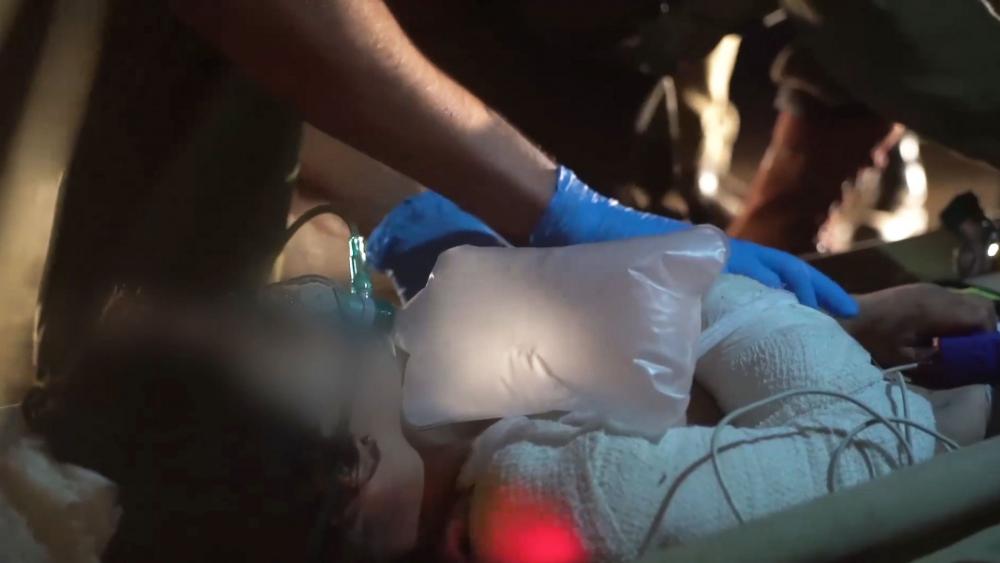
JERUSALEM, Israel – The Syrian army, aided by Russian air power, is seizing more territory and leaving an enormous humanitarian crisis in its wake. The regime's troops captured areas along the borders with Israel and Jordan, plus Syria's main border crossing.

In the eighth year of the Syrian civil war, thousands of civilians find themselves in the crossfire.

From the Israeli side of the border, one can see Syrians on the other side of the fence. The United Nations estimates more than 300,000 civilians have fled the fighting.

Drone footage shows the sea of new tents. The Israel Defense Forces are again reaching out to help those who now call this tent city home.
 
"The main mission is to give as much humanitarian aid to the other side [as possible], an IDF medical officer with the Golan Heights Division told CBN News.

"We do this first because when you understand what's happening on the other side and you know that they don't have anything and they really suffer," he explained. "You cannot stand aside and do nothing. I think it's part of what we know to do…to help other people who need it. They are neighbors on the other side."

Read More: CBN News

Comment

Comment

Largest Hispanic Christian Ministry Joins Friends of Zion to Fight Rising Anti-Semitism

(Photo: CBN News)

(Photo: CBN News)

By CBN News - July 12, 2018

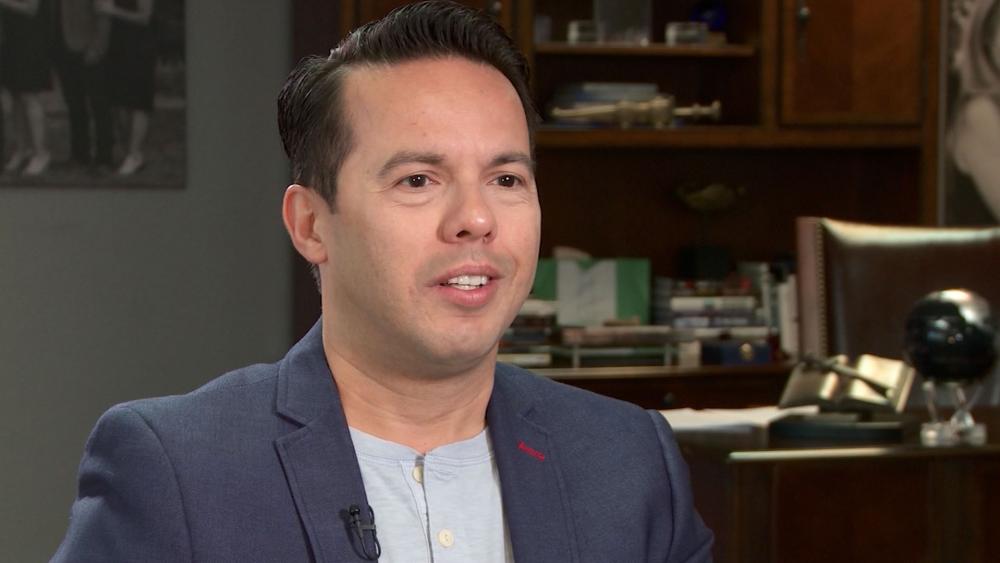
JERUSALEM, Israel – Rev. Samuel Rodriguez, president of the largest Hispanic ministry worldwide, joined Mike Evans, founder of the Jerusalem-based Friends of Zion ministry, to fight the rising tide of anti-Semitism.

"We are proud to partner with Friends of Zion's President's Task Force and with its tireless founder, Dr. Mike Evans," said Rodriguez, president of the National Hispanic Conference and the Hispanic Israel Leadership Organization (HILC).

According to the Friends of Zion Museum website, presidents of major Christian organizations make up the President's Task Force. Such well-known Christian leaders as former governor Mike Huckabee, Dr. Ronnie Floyd, Rev. Jentezen Franklin, Dr. Robert Jeffress and Dr. Jack Graham serve on the task force's executive committee.

"The aim of our partnership is to leverage the unparalleled access and influence of FOZ within Israel, along with the formidable social media and content production capabilities, to further promote pro-Israel values within the Hispanic Christian community around the world," Rodriguez said. "Our message is clear: Israel, her people and her leaders have no truer friends than Hispanic Christians. Our partnership with FOZ will help ensure it stays that way for generations to come."

Read More: CBN News


Comment

Comment

1,600-Year-Old Mosaic Shows Biblical Spies Who Scouted Promised Land

(Photo: Jim Haberman)

(Photo: Jim Haberman)

By Laura Geggel, Senior Writer - July 11, 2018

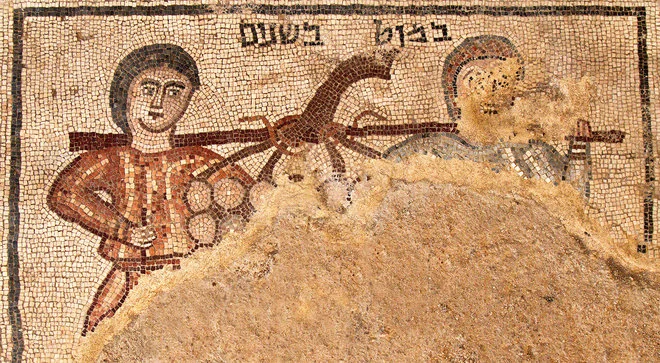
An ancient mosaic depicting two Biblical spies sent to scout the Promised Land has been unearthed at a nearly 1,600-year-old synagogue in northern Israel. 

In the mosaic, two spies carry a cluster of grapes on a pole — likely a reference to an episode in the Book of Numbers in the Hebrew Bible. In that passage, Moses asks 12 spies, including the famous Biblical hero Joshua, to scout out the land of Canaan. Moses had good reason for sending the reconnaissance mission: He wanted to know many people lived in Canaan, whether the soil there was fertile and what the fruit there tasted like, according to Numbers 13:17-13:23. 

The mosaic shows two of those spies just after "they cut off a branch bearing a single cluster of grapes. Two of them carried it on a pole between them, along with some pomegranates and figs," according to the Bible's New International Version translation of Numbers 13:23.

The mosaic is one of about a dozen that archaeologists have uncovered at a synagogue in the ancient Jewish village of Huqoq, in Israel's Galilee. The detail and breadth of these discoveries indicate that the villagers flourished during the early fifth century A.D., when the region was under Rome's Christian rule. 

"The mosaics decorating the floor of the Huqoq synagogue revolutionize our understanding of Judaism in this period," Jodi Magness, a professor of archaeology at the University of North Carolina at Chapel Hill who led the excavation, said in a statement. "Ancient Jewish art is often thought to be aniconic, or lacking images. But these mosaics, colorful and filled with figured scenes, attest to a rich visual culture as well as to the dynamism and diversity of Judaism in the late Roman and Byzantine periods."

Read More: Live Science

Comment

Comment

Archaeologists Uncover Gate to Biblical City of Zer

(Photo: Hanan Shapir) 

(Photo: Hanan Shapir) 

By Tamara Zieve - July 8, 2018 

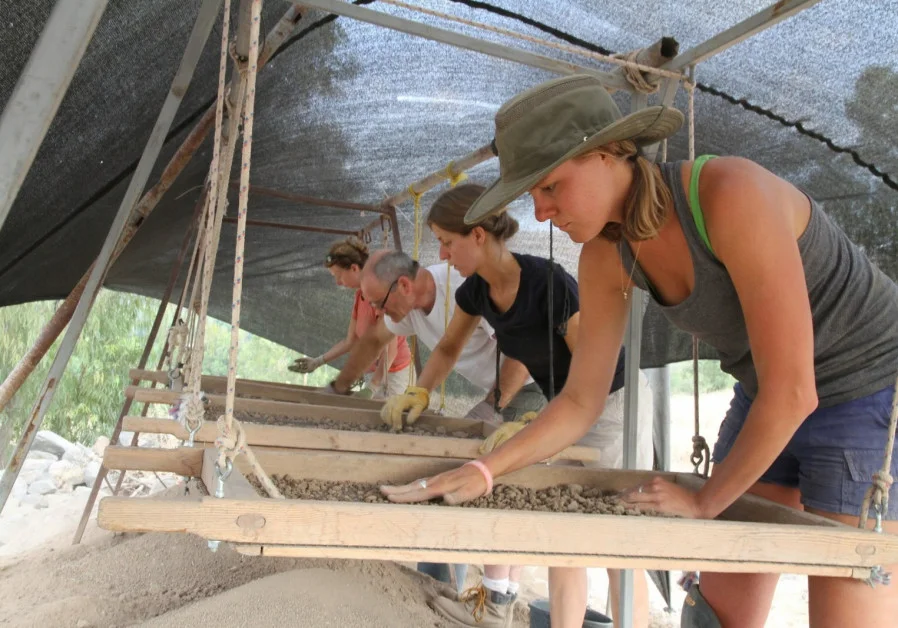
Archaeologists have uncovered the entrance gate to the biblical city of Zer during excavations carried out in the Golan Heights over the past two weeks, the Golan Regional Council said Sunday.

In recent days, and after a year of recess, a group of 20 archaeologists from all over the world, together with director of the Bethsaida Project, Dr. Rami Arav, and under the auspices of the Hebrew Union College, Jerusalem, conducted new excavations in two different areas of Bethsaida. The ancient fishing village is mentioned several times in the New Testament as a city where Jesus lived and where he miraculously fed a multitude of people with five loaves and two fish.

Archaeologists said the size, wealth and impressive fortifications indicate that Zer was a major city.

“There are not many gates in this country from this period. Bethsaida was the name of the city during the Second Temple period, but during the First Temple period it was the city of Zer,” Arav said, pointing to Joshua 19:35, which says: “The fortified towns were Ziddim, Zer, Hammath, Rakkath, Kinnereth.”

Arav began carrying out excavations of et-Tell on behalf of the University of Nebraska nearly 30 years ago. In these excavations, he identified the ancient Bethsaida, and following his excavations and discoveries, masses of Christian pilgrims visited the site because of its great importance to Christianity. 

Read More: The Jerusalem Post

Comment

Comment

New Franciscan museum in Jerusalem shows life in Jesus’ time

(Photo: AP Photo/Caron Creighton)

(Photo: AP Photo/Caron Creighton)

By Ilan Ben Zion - July 7, 2018

AP — Jerusalem’s Franciscan friars have opened a new museum filled with artifacts related to daily life in Jesus’ time.

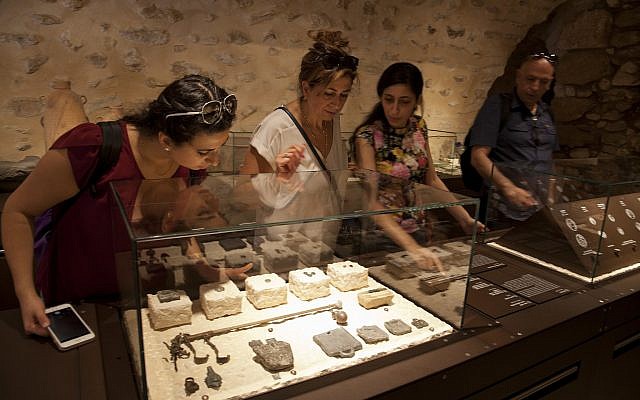
The Terra Sancta Museum’s new wing, built into the ruined remains of Crusader and Mamluk buildings along the Via Dolorosa in the Old City, showcases objects discovered in excavations at biblical sites over the past century.

The Custody of the Holy Land — the Franciscan Order’s organ in Israel, the Palestinian territories, Jordan, Lebanon, and Cyprus — has carried out several archaeological excavations around the region, focusing on sites with connections to the Bible.

Many of the items going on display in the new exhibit, titled “The House of Herod: Life and Power in the Age of the New Testament,” have never been shown to the public. 

Read More: Times of Israel

Comment

Comment

Golden State Warriors star Draymond Green visits Israel

(Photo: GPO)

(Photo: GPO)

By JTA - July 5, 2018

JERUSALEM (JTA) — Draymond Green, an All-Star forward for the NBA champion Golden State Warriors, met in Jerusalem with Israel’s president.

Green presented Reuven Rivlin with a Warriors jersey during their meeting Wednesday. The basketball player is in Israel as part of a visit organized by the Friends of the Israel Defense Forces, Hadashot News reported.

“It’s not every day that I meet an All-Star,” Rivlin told Green. He also tweeted a welcome to Green.

Rivlin said that like many Israelis, he watched the NBA Finals between the Warriors and the Cleveland Cavaliers live, which is very early in the morning in Israel. The Warriors swept the Cavs to win their second consecutive title and third in four seasons, all at the expense of the LeBron James-led Cleveland squad.

“You did not have a simple task, defending LeBron James,” the president told Green. “You’re an amazing team, and it was a true pleasure to watch you play. I hope this will only be the first of many visits.” 

Read More: JTA


Comment

Comment

Taylor Force’s father hopes ‘pay-for-slay’ law will help Palestinians in need

WhatsApp-Image-2018-07-02-at-11.51.00-e1530552617632-1024x640.jpeg

By Raoul Wootliff - July 2, 2018 

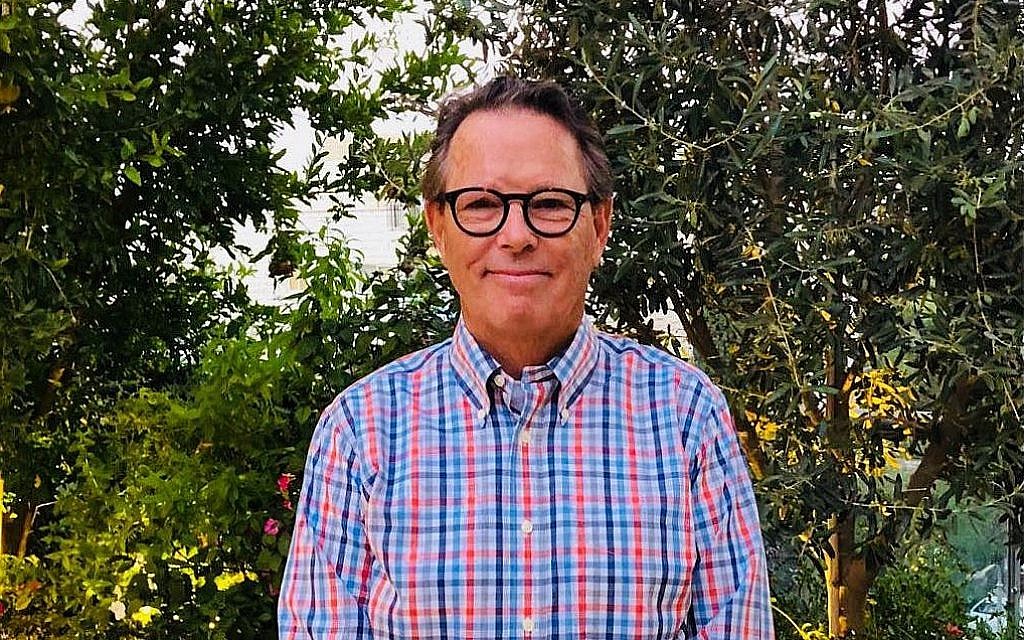
In the two years since his son was killed in a terrorist stabbing spree in the coastal Israeli city of Jaffa, Stuart Force has become a regular traveler from his home town in South Carolina to Washington, DC, where he lobbied US lawmakers to adopt a law limiting aid to Palestinians, until they end stipends for terror convicts and families of slain attackers.

On Monday, three months after the US congress passed the Taylor Force Act into law, Stuart Force traveled for the first time to Israel to see the Knesset pass a similar law to slash funds to the Palestinian Authority by the amount Ramallah pays out to convicted terrorists, a policy nicknamed “pay-for slay.”

Speaking to The Times of Israel ahead of the Monday evening vote, Force said he had made the journey in order to pay back the support he had been shown since the death of his son Taylor.

“The Israeli people have been so supportive of the Taylor Force Act, and it feels right for me to be here and support them,” he said. “t’s going to be very emotional for me to be there during the vote, I’m sure, but I’m glad to be witnessing it. It’s important to our family that I’m here.”

An MBA student at Vanderbilt University in Tennessee and a West Point graduate, the 29-year-old Taylor Force was visiting Israel in March 2016 when he was stabbed to death by 22-year-old Palestinian Bashar Massalha. Force’s death elicited a passionate response from US lawmakers, who, in response, took up the hot-button issue of PA funding to Palestinian terrorists.

According to Israel’s Defense Ministry, the PA in 2017 paid NIS 687 million ($198 million) to the so-called “martyrs’ families fund” and NIS 550 million ($160 million) to the Palestinian Prisoners’ Club — some seven percent of its overall budget.

Palestinian prisoners serving 20- to 30-year sentences for carrying out terror attacks are eligible for a lifetime NIS 10,000 ($2,772) monthly stipend, the Defense Ministry said, citing PA figures. Those prisoners who receive a three- to five-year sentence get a monthly wage of NIS 2,000 ($554). Palestinian prisoners who are married, have children, live in Jerusalem, or hold Israeli citizenship receive additional payments.

The Defense Ministry last month released figures alleging that some terrorists who killed Israelis will be paid more than NIS 10 million ($2.78 million) each throughout their lifetimes by the PA.

Stuart Force said he was shocked to learn of the payments, and bewildered at how countries, including the US and Israel, allowed their own foreign aid funds to the Palestinians to go to terrorists.

Read More: Times of Israel 
 

Comment

Comment

Israeli residents go public with heartfelt aid to Syrians

(Photo: Basel Awidat/Flash90)

(Photo: Basel Awidat/Flash90)

By Abigail Klein Leichman - July 3, 2018

“Salam Aleikum” began the letter that hundreds of Syrian refugees found attached to tents they received last week via the Israel Defense Forces’ Operation Good Neighbor.

The letter was hastily written in English by Gal Lusky, who has been supplying humanitarian aid to Syrian victims of the civil war since 2011 through her secretive nonprofit, Israeli Flying Aid.

Finally, she wanted to introduce herself.

“Although you are considered to be our sworn enemies and although by operating in the field our volunteers were risking their lives, as the descendants of Jews that survived the Holocaust, we, the volunteers of Israeli Flying Aid, proud Jewish citizens of the State of Israel, sanctify life and will not stand idly by as women and children are continuously slaughtered,” Lusky wrote.

Within 24 hours, she started receiving emails in response — including children’s drawings that brought tears to her eyes.

“I’m so emotional about it,” Lusky tells ISRAEL21c. “I needed those people to know who we are. I want them to feel a tiny bit of solidarity, to fill their souls as well as their stomachs.” 

Read More: Israel21c


Comment

Comment

Miss Iraq Sarah Idan Cries During Visit to Babylonian Jewry Heritage Center

sarah-idan-15.jpg

By Aussie Dave - June 15, 2018

During her trip to Israel, the wonderful Sarah Idan, Miss Iraq 2017, visited the Babylonian Jewry Heritage Center and met with Iraqi Jews. By all accounts (and as you will see from some of the below photos), she was very moved (to the point of crying) by the museum exhibitions, especially a seal on which was written the words “not allowed to return to Iraq” – to which she responded “I am ashamed.”

As part of the visit, Prof. Efraim Sadka spoke about how Muslim and Christian neighbors protected and saved the Jews in Baghdad during the “Farhud” – the Pogrom of 1941. Sarah was surprised to see the photo of Renee Dangoor – Baghdad Beauty Queen of 1947.

Read More: israellycool.com


Comment

Comment

Israeli children counter flaming kites with peace balloons

(Photo: Twitter screenshot, Nir Dvori)

(Photo: Twitter screenshot, Nir Dvori)

By TOI Staff - June 15, 2018

As the Hamas terror group threatened to launch 5,000 flaming kites and balloons at Israel on Friday, Israeli children at the Gaza border countered with a message of peace.

At Kibbutz Nir Am, which has had a number of fires sparked by burning kites flown from Gaza, children and residents launched balloons carrying candy towards the Palestinian enclave, Hadashot TV news reported.

Additionally, kibbutz members on Saturday will replant groves at Nir Am burned by the kites in a message of “they burn and we plant,” the network said.

Read More: Times of Israel


Comment

Comment

3 initiatives awarded prize for Israeli-Arab peace efforts

(Photo: Yonatan Sindel/FLASH90)

(Photo: Yonatan Sindel/FLASH90)

By Rebecca Stadlen Amir - June 13, 2018

Three pairs of Jewish Israelis and Muslim Arabs were awarded the 14th annual Institute of International Education (IIE) Victor J. Goldberg Prize for Peace in the Middle East in Jerusalem today (June 13), recognizing their work toward advancing peace and reducing tensions in the region.

“This award recognizes innovation, and rewards those who are courageous and committed enough to work together to overcome the religious, cultural, ethnic and political issues which divide the Middle East,” said former IBM executive Victor J. Goldberg, a longtime IIE trustee who created and endowed the prize in 2005.

The three winners include Mosaica Religious Peace Initiative, the PeacePlayers, Middle East Tamra/Naharia All-Star team, and Change Agents. The prize awards $30,000 split among the three pairs of individuals involved.

Read More: Israel21c


Comment

Comment

Iranians defy regime on Twitter, express support for Israel

iran-israel-westandwithisrael-1-e1528860101297-640x400.jpg

By TOI Staff - June 13, 2018

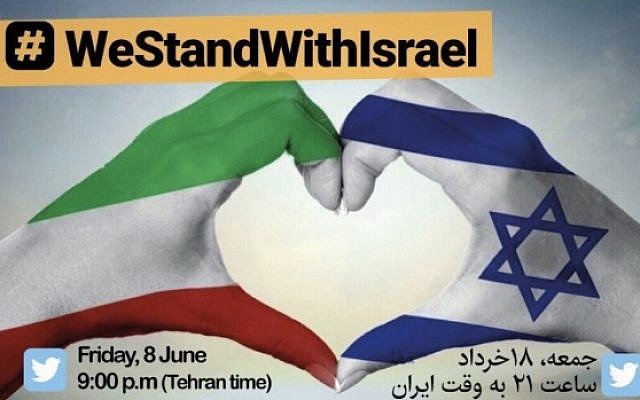
As thousands marched in Iran on Friday to mark the regime-led Quds Day — an annual day of protest against Israel — some Iranians launched a Twitter campaign to express support for the Jewish state.

The effort, under the hashtag #WeStandWithIsrael, was a call for peace between the two peoples. A photo shared on the social media platform encouraged users to tweet the hashtag at 9 p.m. Tehran time on Friday.

A Foreign Ministry official on Tuesday said the hashtag had featured in tens of thousands of tweets.

“The Foreign Ministry implements digital public diplomacy in social media networks in various languages, one of them being Persian,” the ministry’s Persian digital media manager Sharona Avginsaz said.

“In the last six months our Twitter page ‘Israel in Persian,’ intended specifically for Iranian civilians, has been gaining steam,” she told the Mako website, run by Hadashot news. “We have around 60 thousands followers, and our messages reach over 1.5 million people with that Twitter handle alone.”

She explained that though Twitter is banned in Iran, many Iranians have found ways to circumvent the restrictions.

Read More: Times of Israel

Comment

Comment

King who? Rare sculpted head of mystery biblical ruler found in northern Israel

(Photo: AP Photo/Ilan Ben Zion)

(Photo: AP Photo/Ilan Ben Zion)

By Ilan Ben Zion - June 9, 2018

AP — An enigmatic sculpture of a king’s head dating back nearly 3,000 years has set off a modern-day mystery caper as scholars try to figure out whose face it depicts.

The 5-centimeter (2-inch) sculpture is an exceedingly rare example of figurative art from the Holy Land during the 9th century BCE — a period associated with biblical kings. Exquisitely preserved but for a bit of missing beard, nothing quite like it has been found before.

While scholars are certain the stern bearded figure wearing a golden crown represents royalty, they are less sure which king it symbolizes, or which kingdom he may have ruled.

Archaeologists unearthed the diminutive figurine in 2017 during excavations at a site called Abel Beth Maacah, located just south of Israel’s border with Lebanon, near the modern-day town of Metula.

Nineteenth-century archaeologists identified the site, then home to a village called Abil al-Qamh, with the similarly named city mentioned in the Book of Kings.

During the 9th century BCE, the ancient town was situated in a liminal zone between three regional powers: the Aramean kingdom based in Damascus to the east, the Phoenician city of Tyre to the west, and the Israelite kingdom, with its capital in Samaria to the south.

Kings 1 15:20 mentions Abel Beth Maacah in a list of cities attacked by the Aramean King Ben Hadad in a campaign against the Israelite kingdom. 

Read More: Times of Israel

Comment

Comment

From other end of world, group races to preserve Middle East’s Jewish heritage

(Photo: Larry Luxner/ Times of Israel)

(Photo: Larry Luxner/ Times of Israel)

By Larry Luxner - June 5, 2018

ROCKVILLE, Maryland — Even at the time of the early Muslim empires in the 7th century, Jews had already been established in Arab lands for hundreds of years.

Vibrant communities flourished throughout the Middle East, with synagogues dotting the skylines of major cities from Algiers to Aleppo.

Over time, the Jews built up an extensive cultural legacy — a cemetery in Sudan; Hebrew-language inscriptions in Iraq; hidden fortresses of ancient Israelites in Saudi Arabia. Around the time of Israel’s establishment in 1948, however, things took a turn for the worse as Jews were forced to flee the Muslim-majority countries.

Now, as climate change, human development and terrorism threaten to obliterate what remains, one nonprofit organization is racing to safeguard this legacy before it’s too late.

Since 2010, Boston-based Diarna (“our home” in Judeo-Arabic) has used the latest in 3-D digital mapping technology alongside traditional scholarship and oral interviews to document more than 2,500 Jewish sites in the Middle East and North Africa. 

Many of these sites are found in Morocco (460), Iraq (352), Algeria (320), Yemen (301), Tunisia (231) and Syria (63).

“When I talk about Jewish fortresses in Saudi Arabia, I get blank stares. But this highlights a forgotten history and also the sensitive nature of the work we’re doing,” said Jason Guberman, Diarna’s co-founder and coordinator.

Read More: Times of Israel


Comment

Comment

Israel sends relief to Guatemala after deadly volcano

(Photo: ZAKA)

(Photo: ZAKA)

By Nicky Blackburn - June 4, 2018

Israel is sending emergency aid money to Guatemala after a devastating volcanic eruption that killed at least 25, injured hundreds, and left cities in the region covered in ash.

In a statement today, Israel’s Foreign Ministry announced that it was sending $10,000 to Guatemala through its embassy there, for emergency supplies including medicine, food and blankets.

Israeli trained first responders in Guatemala are also on their way to help after the Volcan de Fuego erupted on Sunday, spewing molten rock, ash and black smoke into the sky, in what is thought to be the worst eruption since 1974, according to local experts.

The volunteers were trained earlier this year by Israel’s ZAKA International Rescue Unit. The three-day search and rescue course in Guatemala was designed to give local volunteers the necessary skills to offer immediate assistance to emergency forces in the event of a mass casualty incident in their communities or regions.

Read More: Israel21c


Comment

1 Comment

CNN recommends Tel Aviv as the top place to visit this June

(Photo: Shutterstock)

(Photo: Shutterstock)

By Kate Mackay - May 30, 2018

Originally appeared here on CNN

(CNN) — Deciding where to travel in June can be tough. School is out in many parts of the Northern Hemisphere. Families are flocking to beaches and national parks, and prices for airfare and accommodations are rising steadily with temperatures in this part of the world. It can feel like there's nowhere to turn.

You'll likely encounter larger crowds and higher prices at most destinations with pleasant weather this month, but you needn't fret. We've done the travel research for you.

Whether you want to explore ancient ruins, hit the beach or the museum, kayak through a canyon or stay out all night in a vibrant city, here are five great places to visit in June:

1. Tel Aviv, Israel
Spring and fall are Tel Aviv's less-expensive shoulder seasons, but there's a reason summer is its most popular. Europeans, in particular, flock to Israel's Mediterranean coast this time of the year.

Israel's second most populous city of course has its fair share of historical and cultural points of interest. Tel Aviv's White City was named a UNESCO World Cultural Heritage Site in 2003. This area contains over 4,000 buildings built in the Bauhaus or International Style -- the most of any city in the world. Architectural tours can be taken through the Bauhaus Center. Read More


1 Comment

Comment

Israel unveils plan to pump billions into neglected Arab areas of East Jerusalem

(Photo: Hadas Parush/Flash90)

(Photo: Hadas Parush/Flash90)

By AP - 1 June 2018

Originally appeared here in the Times of Israel

The government on Thursday unveiled what it billed as a groundbreaking program to invest hundreds of millions of dollars in long-neglected Palestinian neighborhoods of East Jerusalem.

The “Leading Change” program aims to reduce the huge social gaps between the Palestinian neighborhoods and the overwhelmingly Jewish western part of the city. Palestinian neighborhoods suffer from poor infrastructure, neglect and subpar public services, and nearly 80 percent of the city’s Palestinian families live in poverty.

The program will invest NIS 2 billion, or $560 million, in three core areas: education, infrastructure, and helping Palestinian women enter the work force.

The money will be spent on a variety of programs, including nine pilot projects, in the coming five years, with the aim of attracting further government and private investment down the road. Read More

Comment