Comment

Israel backs Rwanda’s school internet connectivity effort

By Hudson Kuteesa - December 13, 2021

The State of Israel through the Embassy of Israel in Rwanda has contributed Rwf100 million to purchase computers and other devices for teachers whose schools are being connected to the internet under the Giga project (“smart classes").

The Giga project was launched in 2019 by the United Nations Children’s Fund (UNICEF) and the International Telecommunication Union (ITU), with the aim to provide connectivity to every school in the world by 2030.

As co-chair of the UN Broadband Commission, Rwanda supported the initiative and in 2020, was chosen to lead its implementation in Africa.

Speaking about the funding, Ron Adam, the Ambassador of Israel to Rwanda commended the strides Rwanda's education sector has made over the years, noting that Israel is pleased to support the country’s ground-breaking goal of universal connectivity in schools.

“Education is the foundation of everything, and this goes hand in hand with the quality. In this era, you can’t talk about quality while excluding technology," he said.

Read More: The New Times

Comment

Comment

Israeli study: Mothers’ smartphone use could damage toddler development

By Stuart Winer - December 21, 2021

Parents distracted by their smartphones could be causing long-term developmental damage to their toddlers because they aren’t interacting with them enough, according to a recently published study by researchers at Tel Aviv University.

The research found that interaction between mothers and toddlers is reduced by up to a factor of four when the mother is using her smartphone, the university said in a statement about the research.

“The consequences of inadequate mother-child interaction can be far-reaching,” cautioned Katy Borodkin of the Department of Communication Disorders at the Stanley Steyer School of Health Professions, Sackler Faculty of Medicine, and who led the study.

There is a “high probability” that the research findings apply to fathers as well, Borodkin said, as men and women have similar patterns of use for their smartphones.

Borodkin noted there is currently no research suggesting that parental use of smartphones actually affects child development, “as this is a relatively new phenomenon,” but the findings indicate an “adverse impact on the foundation of child development.”

Read More: Times of Israel

Comment

Comment

Chilean diplomat who saved over 1,200 during the Holocaust honored

(Photo: Yad Vashem)

By Marcel Gascon Barbera/JTA - December 30, 2021

A group of diplomats and local Jewish leaders honored a late Chilean diplomat whose story of saving over 1,200 Jews during the Holocaust is not widely known.

Samuel del Campo, who as a diplomat stationed in Romania during World War II issued Chilean and Polish passports to Jews who would have been deported to Nazi camps, was given a tribute at the Great Synagogue in Bucharest last Tuesday. The ceremony was attended by the Chilean, Polish and Israeli ambassadors to Romania.

“The story and actions of Samuel del Campo in Romania as the Republic of Chile’s chargé d’affaires represent a light of human dignity in a moment of history in which everything was surrounded by darkness,” said Silviu Vexler, president of the Federation of the Jewish Communities of Romania and a member of the Romanian parliament, in a speech.

Read More: Jerusalem Post

Comment

Comment

Israeli 3D Printing Firm Designs Fashion Forward Neck Brace For Wounded Soldier

By Simona Shemer - December 7, 2021

Twelve years ago, Moran Barashi was a canine handler in the Israeli Air Force — training dogs to help during patrols — when she was in a car accident that flipped her jeep at the Palamachim base. Barashi woke up in the hospital, with no memory of the accident, but the repercussions were severe. She had a neurological injury in her neck that caused tics and pain ran continuously throughout her body.

The tics were frequent and disruptive to everyday life and Barashi began receiving botox injunctions to paralyze her muscles so the visibility of the tics would be weakened. While the injections helped, they also created other problems. Even years later, the injury continued to pose a challenge for the Hadassah College industrial design student and veterinarian.

“I had a very hard time holding my head up,” Barashi tells NoCamels. “I have a lot of muscles that are paralyzed from all the shots. It makes my daily life difficult and affects my whole body.”

While she is supposed to wear a brace around her neck all day long, existing solutions make her itchy, sweaty, uncomfortable, and cut off her air. The plastic smells after prolonged wear, she says. The neck brace has also been too ugly, hard, and plain for the self-proclaimed fashionista. “I wanted everyone to look at me because of my clothing, not my neck,” she explains.

Read More: NoCamels

Comment

Comment

Palestinian workers in Israel’s high-tech industry

(Photo: Wisam Hashlamoun/Flash90)

By i24NEWS - December 29, 2021

Israel’s high-tech industry is seeing a growing number of Palestinians from the West Bank making the commute to contribute to the sector.

Considered as a major player in the world’s tech industry - with record levels of foreign investments in 2021 - Israel is home to major high-tech firms like Microsoft and Intel.

It comes as no surprise that young, educated people find Israel a prime work destination, including Palestinians.

“I did not expect to work in Israel in high-tech. It was unimaginable,” Inas Awad, an employee of the Israeli high-tech firm Colabo, told i24NEWS.

Read More: i24NEWS

Comment

Comment

IsraAID supplies urgent needs in typhoon-hit Philippines

By Abigail Klein Leichman - December 27, 2021

IsraAID, an Israeli non-governmental humanitarian aid organization, has deployed an emergency response team in the Philippines following Super Typhoon Rai, known locally as Odette.

The team is delivering safe water and hygiene kits to communities affected by Odette in Southern Leyte and Cebu provinces.

The super typhoon exited the country on December 18, having made nine landfalls over two days and leaving an estimated 2.4 million Filipinos in need of assistance due to severe flooding, landslides and large-scale destruction.

Read More: Times of Israel

Comment

Comment

Israel’s Christian community is growing, 84% satisfied with life here – report

(Photo: Nati Shohat/Flash90)

By TOI Staff - December 22, 2021

Israel’s Christian community grew by 1.4 percent in 2020 and numbers some 182,000 people, with 84% saying they were satisfied with life in the country, the Central Bureau of Statistics said in a report released ahead of Christmas.

The report, released Tuesday, came several days after Christian leaders in the Holy Land warned that their communities are under threat of being driven from the region by extremist Israeli groups, and called for dialogue on preserving their presence.

However, the statistics released by the CBS painted a different picture, indicating the community was growing and prospering, with particularly high tertiary education rates compared to the rest of the population.

According to the CBS, Christians make up about 1.9% of Israel’s population and grew by 1.4% in 2020.

Christians make up 7% of Israel’s Arab population, and 76.7% of Christians in Israel are Arab. The largest Arab Christian population centers in Israel are Nazareth (21,400), Haifa (16,500) and Jerusalem (12,900).

Read More: Times of Israel

Comment

Comment

Israelis flood Nazareth for Christmas celebrations, while Bethlehem subdued

(Photo: Ahmad Gharabli/AFP)

By Claire Gounon - December 24, 2021

Tens of thousands of people visited Nazareth on Friday for the traditional Christmas procession despite the lack of international tourists, a welcome change for residents after last year’s cancellation of major events due to the pandemic.

The atmosphere in the city where Christians believe Jesus lived was cheery as the parade moved from the Temple of Mary along Paul VI Street, with visitors bustling along between shops and stalls offering food and holiday trinkets.

The event was lively despite fears of rising infections as a result of the Omicron variant of coronavirus.

With Israel closed to tourists and its citizens restricted from traveling abroad, the mainly Arab city of Nazareth, normally a magnet for Christian pilgrims, has been thronged with Jewish visitors.

Livnat Kizner, from central Israel, told Ynet that visiting the city was a good substitute for a trip abroad. “It’s very reminiscent of Europe, in the sounds, the smells, the experience. You can definitely have fun in Israel in such places and not fly,” she said.

Read More: Times of Israel

Comment

Comment

Underwater treasure: 1,700-year-old coins among shipwrecked items found off Caesarea

(Photo: Dafna Gazit/Israel Antiquities Authority)

By Amy Spiro - December 22, 2021

Marine archaeologists diving off the coast of Caesarea have discovered a number of ancient artifacts in recent months, including some dating back to the third century, the Israel Antiquities Authority revealed on Wednesday.

The finds came from the wrecks of two ships that went down near the northern coastal town during the Roman and the Mamluk periods.

“The ships were probably anchored nearby and were wrecked by a storm,” said Jacob Sharvit and Dror Planer of the IAA’s Marine Archaeology Unit.

“They may have been anchored offshore after getting into difficulty, or fearing stormy weather, because sailors know well that mooring in shallow, open water outside of a port is dangerous and prone to disaster,” they added.

Some of the most intriguing finds include those believed to be personal effects of those on board.

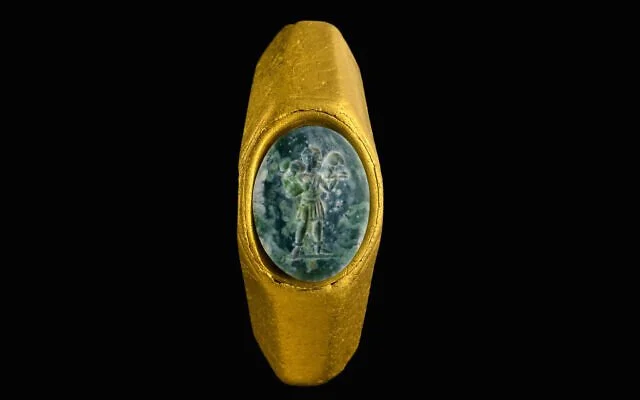
Archaeologists discovered a thick gold ring with an inlaid green gemstone that depicts a young shepherd boy dressed in a tunic with a ram or sheep on his shoulders.

The image is believed to be the Christian symbol of the “Good Shepherd,” an early depiction of Jesus as a benevolent figure, suggesting its owner was likely an early Christian.

Read More: Times of Israel

Comment

Comment

Israeli tissue engineers 3D-print an ear

(Photo: Technion Spokesperson’s Office

By Brian Blum - December 19, 2021

A small percentage (0.1% to 0.3%) of babies are born with congenitally deformed ears. This can have a severe psychological impact, and sometimes involves hearing loss.

While surgeons can reconstruct a proper ear using cartilage harvested from the patient’s chest, the procedure is not usually performed until at least 10 years of age.

Researchers at the Technion-Israel Institute of Technology and Sheba Medical Center have developed a way to 3D-print “scaffolding” as the basis for a replacement ear.

The scaffold, which allows for the formation of an aesthetic and stable auricle (the visible part of the external ear), is designed from a CT scan of the patient’s ear and can be performed on children as young as six years old.

Read More: Israel21c

Comment

Comment

Classical music fest in Nazareth brings Arabs, Jews together for Christmas

(Photo: Yoel Levy)

By Jessica Steinberg - December 17, 2021

When Nazareth’s Liturgical Festival kicked off Thursday night with an opening concert celebrating 250 years of Beethoven, every seat at the performance, held in the city’s Salesian Church, was filled. The concert was completely sold out.

“It’s the first time that the whole festival is sold out,” said Nabil Abboud Ashkar, violinist and director of the Polyphony Conservatory in Nazareth, which runs the annual event. “That’s very rare and rewarding right now.”

About 35 percent of the audience is local, including Christian and Muslim Nazarenes who support the conservatory. The rest of the attendees at the weekend festival will mostly be Jewish tourists from out of town. Some may be long-time fans of the conservatory, but many are simply people who want a weekend away in a nearby destination that feels somewhat, well, foreign.

“Nazareth feels like you’re getting away,” said Abboud Ashkar. “We have the ability to offer both tourism, a special Christmas atmosphere and high culture. That’s the whole idea behind the festival; culture and tourism to motivate integration.”

The festival, held annually during the Christmas season, allows the conservatory to open its doors and reach out to the wider community, helping break down perceptions and bring together the Jewish and Arab communities to hear classical works performed in the city known as Jesus’s childhood hometown.

Read More: Times of Israel

Comment

Comment

Israel Delivers Water Pallets to Tornado-Ravaged Kentucky Communities in Joint Aid Truck With Chabad

(Photo: Chabad of Kentucky / Twitter screenshot)

By Sharon Wrobel - December 14, 2021

The Israeli government, Jewish groups and an Israeli non-governmental humanitarian aid agency are stepping up efforts to help communities hit by devastating tornadoes in Kentucky.

Alex Gandler, Deputy Consul General of Israel’s mission to the Southeast in Atlanta, told The Algemeiner that after Prime Minister Naftali Bennett’s pledge on Sunday to “offer any assistance needed,” it was decided to donate pallets of water to those affected by the storms in western Kentucky.

In Kentucky, which bore the brunt of the tornadoes that struck the central US Friday, at least 74 have lost their lives and more than 109 are reported as unaccounted for. The tornadoes destroyed hundreds of houses, leaving many of those who survived homeless, with some 28,000 homes and businesses still without power Tuesday.

“We stand with our friends in Kentucky at this difficult time and will continue to offer any support that we can,” Gandler said in an emailed statement.

The Consulate General of Israel to the Southeast partnered with Chabad of Kentucky to deliver the water and additional supplies to three locations in Graves County on Monday. Gandler said the Israeli Consulate in Atlanta is also in contact with the Kentucky Governor’s office, the Kentucky Emergency Management and elected officials, to continue to provide support to hard-hit areas as needed.

Read More: Algemeiner

Comment

Comment

Stopping a suspect car, police find ancient items Bar Kochba rebels took from Romans

(Photo: Yoli Schwartz/Israel Antiquities Authority)

By Luke Tress - December 15, 2021

Israeli archaeologists believe ancient artifacts recently seized by police were spoils of war taken by Jewish rebels from their Roman enemies nearly 2,000 years ago.

Israel’s Antiquities Authority said Wednesday that the artifacts, including ornamental incense burners and a wine jug, may be battle loot dating back to the Bar Kochba revolt in 132-136 CE.

Police found the items during a routine patrol in Jerusalem’s Musrara neighborhood last week when detectives stopped and searched a suspicious vehicle that was driving the wrong way on a one-way street. In the trunk they found a box containing the archaeological artifacts.

The IAA’s Robbery Prevention Unit arrived at the police station and quickly determined that the finds date back to the Roman era.

The artifacts include bronze incense burners, which likely belonged to wealthy Roman homes or temples, and a bronze wine server decorated with a banquet scene depicting a person reclining with a jug of wine.

Authorities also found an ornate three-legged stone bowl, Roman clay lamps and hundreds of coins from the late Roman period in the 2nd-3rd centuries CE.

Read More: Times of Israel

Comment

Comment

Historic first meeting: Israeli prime minister meets Emirati crown prince

(Photo: Haim Zach/GPO)

By Lahav Karkov - December 13, 2021

Prime Minister Naftali Bennett and United Arab Emirates leader Crown Prince of Abu Dhabi Sheikh Mohammed bin Zayed Al Nahyan on Monday became the first leaders of their respective countries to meet.

MBZ, as the Emirati leader is known, accepted an invitation from Bennett to visit Israel.

“We held deep, honest and significant conversations,” Bennett said after the meeting. “We spoke about the relative strengths of the two countries, and our goal is to broaden the connection so that there will not only be peace between leaders but peace between peoples.”

Bennett said he is very optimistic that the UAE-Israel relationship, established in August 2020 as the Abraham Accords, will set an example that will be followed throughout the region.

A joint statement from the two leaders’ offices called Bennett’s visit “successful” and “another milestone in the development of warm relations and a tremendous partnership forged between the two countries.”

Read More: Jerusalem Post

Comment

Comment

Gaza boy, 11, becomes 6,000th child saved by Israeli humanitarian group

(Photo: Save a Child’s Heart)

By Israel Hayom - December 13, 2021

Mazen, an 11-year-old boy from the Gaza Strip, this month became the 6,000th child saved by the Israeli humanitarian organization Save a Child’s Heart (SACH), with support from the German foundation Ein Herz für Kinder.

Shortly after Mazen was born, doctors in Gaza diagnosed him with a complicated congenital heart condition that would require multiple medical procedures. As Mazen grew older, he began having difficulty breathing. To survive, he needed emergency surgery.

There are no centers for interventional cardiac treatment in the Gaza Strip, and the caseload of patients in critical condition has worsened under the COVID pandemic. Two Gaza-based doctors—Abdalraheem Said and Hany al-Faleet—are responsible for screening pediatric cardiac patients from the southern part of Gaza at the European Gaza Hospital.

“A major challenge for us is that we are not only responsible for ‘doing the medicine,’ but for helping patients cross borders for care,” said al-Faleet, who referred Mazen to his Israeli partners at Save a Child’s Heart in Holon, Israel.
Read More: JNS

Comment

Comment

In Hometown of Mary Magdalene, Israeli Archaeologists Find Second Synagogue

(Photo: Avram Gracier)

By Ruth Schuster - December 12, 2021

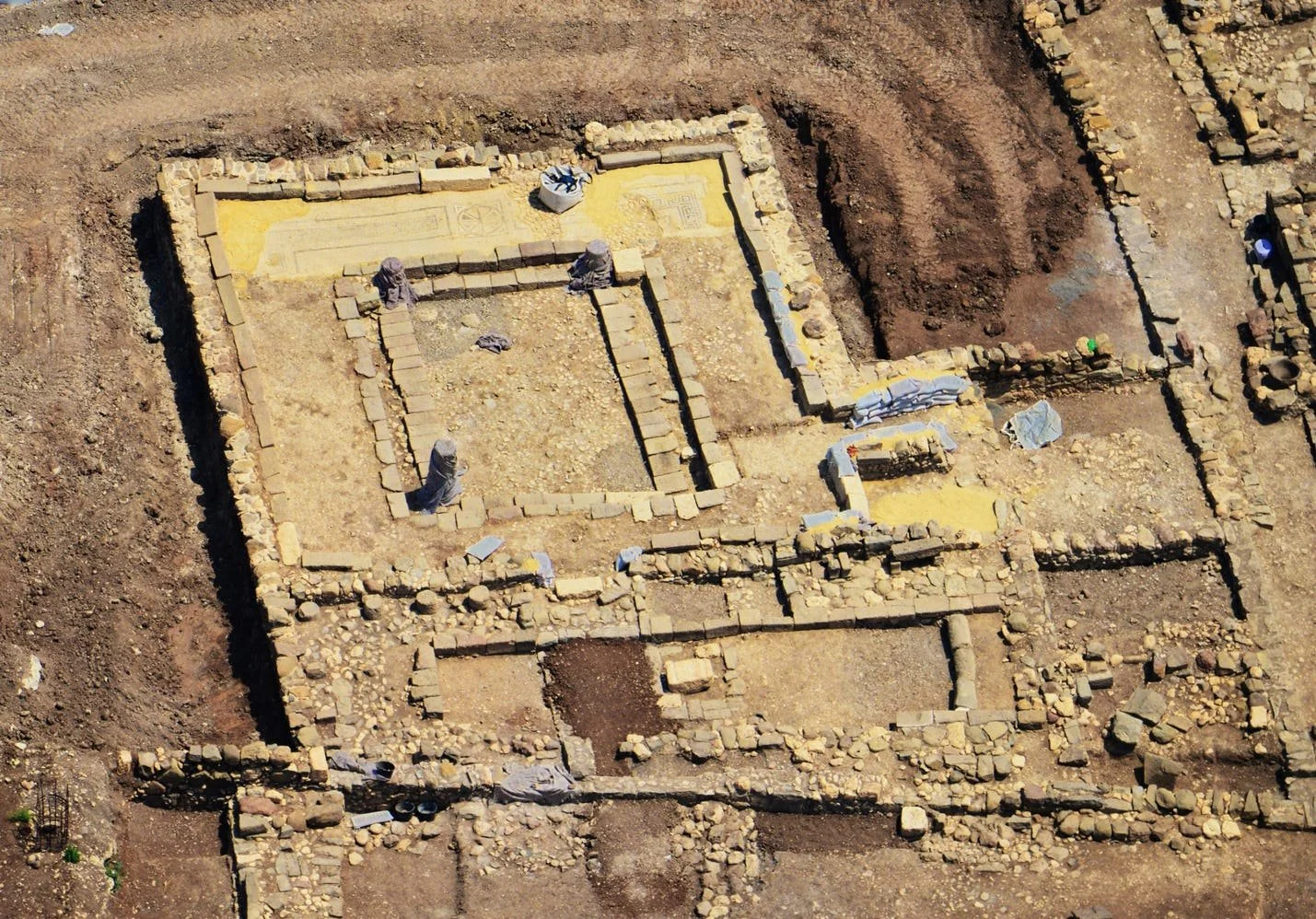
To the surprise of archaeologists excavating the Galilean town of Magdala, today known as Migdal, a second synagogue dating to the Second Temple period has been found.

It is the first time two synagogues from that time have been found in a single town, explain the archaeologists investigating the site. The newly unearthed one is smaller and apparently not as ornate as the first, which was found in 2009, but together they shed new light on the devotion of the people in this Jewish town some 2,000 years ago.

As is so often the case in Israel, the synagogues at Migdal were discovered in salvage excavations by the Israel Antiquities Authority, together with the company Y.G. Contractual and the University of Haifa; and yet again the discoveries were made ahead of building new infrastructure.

The two synagogues were dated by other artifacts found at the site, including glassware, pottery and coins, excavation co-director Dina Avshalom-Gorni explains.

Read More: Haaretz

Comment

Comment

1,900-yr-old skeleton proof of Roman crucifixions - UK archaeologists

(Photo: Victor Armand Poirson/Public Domain/Via Wikimedia Commons)

By Jerusalem Post Staff - December 11, 2021

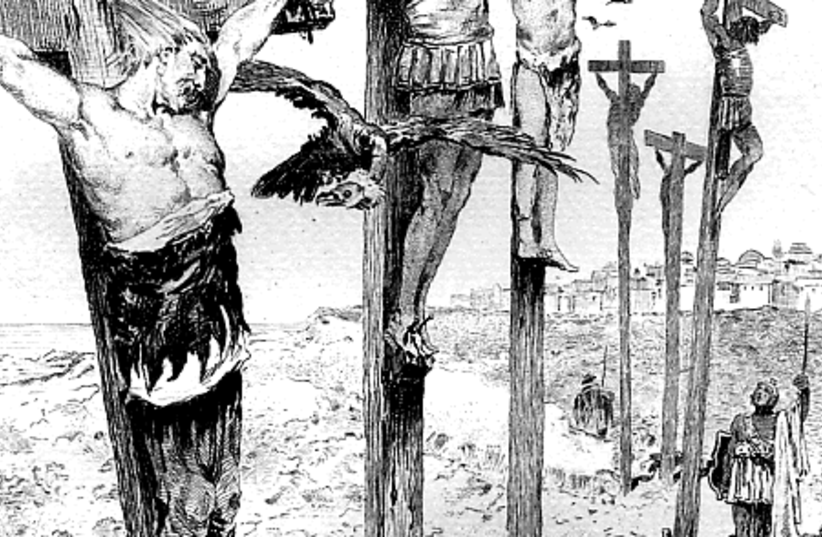
Excavations conducted by English archaeologists yielded a new discovery that may grant insight into the use of capital punishment by the Roman Empire, publishing their findings in British Archaeology magazine on Wednesday.

The team, led by Albion Archaeology's project manager David Ingham, unearthed a skeleton at a Roman settlement in Fenstanton that is almost 1,900 years old, with a nail through the heel bone, suggesting the man was crucified. This is the best evidence of crucifixion by the Romans to date, The Guardian noted.

While experts previously had some knowledge of the use of crucifixion by ancient civilizations, this is "the first tangible evidence to actually see how it worked,” The Guardian quoted Ingham as saying.

Rear More: Jerusalem Post

Comment

Comment

Christmas lights up Jerusalem after Covid hiatus

(Photo: Yonatan Sindel/Flash90

By Abigail Klein Leichman - December 2, 2021

“It felt awesome,” said Rana Fahoum, CEO of the Jerusalem International YMCA, the morning after at least 1,500 people watched the Christmas tree lighting on the regal building’s front lawn.

“Last year we did our Christmas celebrations online; we broadcast our tree lighting through social media. But we were here alone,” she said, as public participation was cancelled due to Covid. “It didn’t feel like our YMCA.”

What a difference a year makes.

“We were so happy to see the front lawn was literally packed,” Fahoum tells ISRAEL21c. “There were even people standing on the outside walls.”

Read More: Israel21c

Comment

Comment

Ancient Hasmonean artifacts found in east Jerusalem at end of Hanukkah

(Photo: Police Spokesperson’s Unit)

By Jerusalem Post Staff - December 5, 2021

Ancient archaeological artifacts thousands of years old, including a coin from the Hasmonean era, were discovered by police in east Jerusalem on Sunday, the last day of Hanukkah.

The artifacts were discovered in a search of the home of an east Jerusalem resident in his 30s. The items were examined by officials of the Antiquities Authority (IAA), and the suspect was arrested and taken in for questioning.

Among the artifacts were a coin dated back to the time of Antigonus II Mattathias, the last Hasmonean king, as well as a Hasmonean-era oil candle and a biblical-era seal ring with ancient Hebrew inscriptions.

The discovery of the Hasmonean-era artifacts came just before the last night of Hanukkah, a holiday celebrating the Hasmoneans’ victory over the Seleucid Empire and the subsequent establishment of independent Jewish rulership of the land.

Read More: Jerusalem Post

Comment

Comment

Israeli archaeologists dig up new info on Sanhedrin era in Yavne

(Photo: EMIL ALADJEM/ISRAEL ANTIQUITIES AUTHORITY)

By Aaron Reich - November 29, 2021

New archaeological findings in the city of Yavne may shed light on the city 2,000 years ago, when it was the center of Jewish life in the region and home to the Sanhedrin.

The discovery saw the first-ever excavation of a building in Yavne dating back to the time of the Sanhedrin.

The Sanhedrin were groups of twenty-three or seventy-one elders who were appointed to sit as a tribunal in every city in the ancient Land of Israel following the destruction of the Second Temple.

The findings of this excavation, initiated by the Israel Antiquities Authority and the Yavne Municipality and Israel Land Authority, indicate that the occupants of this home kept kosher and other Jewish purity laws.

This was evidenced by the presence of "measuring cups," vessels identified with Jews in the late Second Temple era that were used to retain ritual purity.

But another impressive find was found just 70 meters away: A cemetery dating back to the same period. On top of these tombs were over 150 glass phials.

Read More: Jerusalem Post

Comment