Comment

Ancient pottery reveals secrets of Roman rule over Jerusalem – new study

Roman Rule.png

Two thousand years ago, in a Jerusalem buzzing with life, Jewish potters worked around the clock producing pots, jars and stands, as the industry was fueled by a population whose adherence to religious purity laws created an increasing need for clay vessels. New research by Israeli archaeologistshas shed light on this flourishing activity as well as on the dramatic changes brought by the destruction of the Temple and of the city, as the industry progressively passed into the hands of the Romans.

A team of experts from the Israel Antiquities Authority analyzed several pottery workshops uncovered in excavations conducted in the area of the modern Jerusalem International Convention Center and the Crowne Plaza Hotel, revealing how materials and techniques employed, products manufactured and even the identity of those ancient artisans were deeply affected by the historical events in the area. The findings were published in the May 2020 issue of the Bulletin of ASOR – The American Schools of Oriental Research.

“The site we considered is one of the largest pottery workshops in the eastern Mediterranean,” Dr. Anat Cohen-Weinberger, co-author of the paper with Danit Levi and Dr. Ron Be’eri, told The Jerusalem Post. “The workshops were active for about 300 years between the Hasmonean and the Middle Roman periods in the second century CE.”

Cohen-Weinberger heads the IAA Petrographic Laboratory, which has been operating for about 30 years. Petrography aims at studying and identifying rocks and minerals and allows to ascertain their geological source, which helps archaeologists to collect important insights on ancient pottery and its manufacturing.

Read More: Jerusalem Post

Comment

1 Comment

Israeli researchers claim to have successfully produced electricity from plants

PLANTS.png

Israeli researchers have successfully produced electricity from plants in a study by the Director of the Renewable Energy Laboratory at the Faculty of Science at Tel Aviv University, Professor Iftach Yacoby announced on Tuesday.

"All green plants contain real 'solar panels'. They know how to capture a ray of light and transform it into a current of electrons. This is the very meaning of photosynthesis: using sunlight to produce a current electric," the professor told Hebrew media. 

"To connect a household appliance to the electricity, you just have to plug it into an outlet. In the case of a plant, we didn't know where to 'plug' the plugs. We looked for a place in the cells of plants that could serve as an 'input,'" he continues. 

"The green color of plants comes from chlorophyll, which is the basis of its photovoltaic cells. We took one of these cells and injected it with hydrogenase, an enzyme that produces hydrogen, then we introduced this cell into a green micro-algae."

The result being that "the plant which received the genes started to produce advanced photovoltaic cells. We realized that we had found the famous 'plug'," he enthusiastically added.

1 Comment

Comment

Drive-through corona testing in Congo, courtesy of Israel

DRIVE THRU.jpg

BY BRIAN BLUM

It’s not quite as enjoyable as ordering a burger from the car, but Israelis who need to be tested for coronavirus can head to the nearest drive-through testing facility set up by Israel’s Magen David Adom (MDA). Drivers don’t even have to get out of the car to get swabbed.

The Israeli coronavirus drive-through concept is now coming to the Democratic Republic of the Congo in Central Africa.

Congo’s Honorary Consul in Israel, Dan Gertler, saw how Israel was handling coronavirus testing and contacted MDA to help with his country’s fight against COVID-19, the disease caused by the SARS-CoV-2 virus.

Building the drive-through facility is the easy part. What’s trickier is the software that manages the entire process—from sampling to sending the swab off to the lab and responding to patients.

In addition to creating a version of Israel’s software specifically for the Congo, MDA prepared a training program with videos and written materials for the Congolese medical professionals who began operating the facility at the end of May.

“During the long period in which we operated the many drive-through sampling facilities, the technology we used proved itself, along with the effective and safe practices” that prevented infection among MDA’s teams, said MDA chief information officer Ido Rosenblat. “From the moment they contacted us, we were ready to help and to share our knowledge.”

Read More: JNS

Comment

Comment

Stranded at sea? A high-tech Israeli drone can save the day

HIGH DRONE.jpg

BY YAAKOV LAPPIN

Israeli defense company Elbit Systems has announced in recent days that it has sold a unique version of its advanced Hermes 900 Unmanned Aircraft System (UAS) to an undisclosed customer in Southeast Asia.

The Maritime Patrol version of the Hermes 900 features inflated life rafts placed under the wings that the drone drops off from a low altitude to rescue those in the water.

It also features what Elbit described as a “precision dispatch capability.” This means that the system uses a combination of advanced cameras and radar to conduct long-range sea search-and-rescue missions.

It’s able to automatically detect and track any objects of interest—in this case, survivors of a capsized vessel in the sea—using its advanced sensors.

Once it detects the location of survivors, the drone transmits their precise location back to operators sitting in a control cabin. The Hermes 900 enters into an aerial route that is designed to enable it to begin a rescue operation.

The operators provide approval for the rescue, and the system then drops off the life rafts into the water.

In difficult weather conditions, manned aircraft can struggle to conduct search-and-rescue missions, but the Hermes 900 is designed to operate in such conditions and can fly for more than 24 hours continuously, Elbit said in a statement, operating in both day and night.

Read More: JNS

Comment

Comment

Israel Donates Wheelchairs to Coronavirus-Stricken Ecuador

EQUADOR.jpg

Israel donated a shipment of wheelchairs on Friday to the mayor of Quito, the capital of Ecuador, one of the Latin American nations hardest hit by the Covid-19 pandemic.

“The wheelchairs will contribute to the recovery of patients with Covid19 in the Quito Temporary Care Center,” Amir Sagron — deputy chief of mission and consul of Israel in Ecuador — tweeted.

Ecuador, a country of 17 million people, has seen over 40,000 confirmed Covid-19 cases and more than 3,000 deaths.

Read More: Algemeiner

Comment

Comment

Archaeologists might have identified Jezreel winery featured in Bible

MOSAICS.jpeg

By ROSSELLA TERCATIN  

In the biblical books of Kings I and II, the winery of Jezreel is the setting of some of the most gruesome episodes of greed, violence, sin and divine retribution. Researchers have identified elements that confirm the excavation carried out in northern Israel is compatible with the biblical narrative, according to a paper published in the latest issue of the Journal of Eastern Mediterranean Archaeology and Heritage Studies.

The winery was first discovered in 2013 and exposed in several seasons of excavations in following years. It presents several installations carved into the bedrock.

“Naboth the Jezreelite owned a vineyard in Jezreel, adjoining the palace of King Ahab of Samaria. Ahab said to Naboth, ‘Give me your vineyard, so that I may have it as a vegetable garden, since it is right next to my palace. I will give you a better vineyard in exchange; or, if you prefer, I will pay you the price in money.’ But Naboth replied, ‘The LORD forbid that I should give up to you what I have inherited from my fathers!’” reads I King 1:4 (translation Sefaria.org).

It is currently impossible to date with certainty the remains of the ancient winery that was uncovered not far from Jezreel, a settlement that has been continuously inhabited for thousands of years, the lead author of the study, Dr. Norma Franklin of the Zinman Institute of Archaeology at the University of Haifa, told The Jerusalem Post. However, different factors support the idea that whether or not there was a man called Naboth, whoever authored the story must have been aware of the existence of that winery, the only one in the compatible area, she said.

Read More: Jerusalem Post
Comment

Comment

Israel aiming to enable unprecedented human DNA edits, to help cure illnesses

dnaalter.jpg

By NATHAN JEFFAY

Israel is setting up a task force aimed at bringing a new level of accuracy to genome editing, in the hope it will pave the way to cures for various medical conditions.

The state-run Israel Innovation Authority (IIA) has allocated NIS 36 million ($10 million) for the country’s academic institutions and several companies to advance CRISPR, a technology for making edits to the genome.

The consortium, which will work on genome editing for humans, as well as agriculture and fish, will run for 18 months, after which funding may be renewed.

There is widespread excitement in scientific circles about genome editing, after CRISPR was administered, for the first time, inside a human body last month, in an attempt to treat genetic condition that causes blindness.

Genome editing, which involves making changes to DNA, normally to address a health problem, is thought to have potential for common conditions like cancer and blood disorders, but also for rare genetic illnesses for which medicines aren’t developed.

Genome editing is already used in agriculture and research, and it is widely hoped that successes with animals — like reducing the severity of genetic hearing loss in mice — will provide the knowledge that scientists need to advance human health.

Read More: Times of Israel

Comment

Comment

New study dates Temple arch at 2,000-years-old

By ROSSELLA TERCATIN  

Two thousand years ago, Jewish worshipers walked on the Wilson’s Arch located to the left of the Western Wall to access the Holy Temple of Jerusalem, researchers have revealed.

The finding is part of the results of a project carried out in cooperation by the Israel Antiquities Authority, the Weizmann Institute of Science and the Tel Aviv University which were published in the journal PLOS ONE on Wednesday.

The research also led to the discovery of a previously unknown theater-like structure in the area, offering a new extraordinary glimpse into the history of Jerusalem.

As explained to The Jerusalem Post by IAA archaeologist Dr. Joe Uziel, in the past radio-carbon dating has been used only very sporadically in the city and this new initiative aims at dramatically changing the situation in order to “set the clock of remains in ancient Jerusalem.”

For this purpose, the researchers have also pioneered new methodologies identifying organic material in the mortar between the stones to allow the analysis.

Located inside the complex of the Western Wall tunnels, Wilson’s Arch is the last prior to entering the Temple Mount and is named after the British explorer Charles Wilson, who documented it in the second half of the 18th century.

Read More: Jerusalem Post

Comment

Comment

Using DNA technology, Israeli researchers discern new clues to piece together Dead Sea Scrolls

Using DNA technology, Israeli researchers have uncovered new clues about the origins of the Dead Sea Scrolls, providing a new glimpse into Jewish life during the final days of the Second Temple period.Researchers from Tel Aviv University, led by Pro…

Using DNA technology, Israeli researchers have uncovered new clues about the origins of the Dead Sea Scrolls, providing a new glimpse into Jewish life during the final days of the Second Temple period.

Researchers from Tel Aviv University, led by Professor Oded Rechavi of the George S. Wise Faculty of Life Sciences and Professor Noam Mizrahi of the Department of Biblical Studies—working with colleagues from Sweden’s Uppsala University, the Israel Antiquities Authority and Cornell University—have successfully decoded ancient DNA extracted from the animal skins on which the Dead Sea Scrolls were written.

By characterizing the genetic relationships between different scroll fragments, the researchers were able to discern historical connections, including questions over differences in texts found at the caves in Qumran and elsewhere. Containing some of the oldest copies of biblical texts, the Dead Sea Scrolls refers to some some 25,000 fragments of leather and papyrus discovered as early as 1947, mostly in the Qumran caves, but also in other sites in the Judean Desert.

Researchers have long been puzzled over whether or not the works found in the Qumran caves only represent that of a radical sect of Judaism, known as the Essenes, or if they were a collection that reflects the broad cultural milieu of Second Temple Judaism.

Comment

Comment

What Israel can teach the world about beating a pandemic

covid 19 teach.jpg

By Jonathan Frenkel

So far, Israel, the Startup Nation, has been able to contain Covid-19 and has slowly begun reopening the country’s economy.

As we ease into a “new normal,” we can now look back at how Israel has been able to overcome this first wave of the pandemic with relatively few  deaths – 279 to date. (Please see updated editor’s note below.)

Israel’s best practices could serve as an example to US states and other countries currently working to reopen their economies amid a shrinking number of infections.

Choosing the right strategy

Israel’s strategy to close its borders to outside travelers in early March and take aggressive measures to lock down the country was not a given.

When you look at countries such as Sweden that opted for herd immunity, they basically sacrificed their elderly and immunocompromised citizens. Sweden, with a population close in number to Israel’s, has suffered an exponentially greater number of deaths (3,992) by letting the virus spread.

At the beginning, Israelis debated about whether putting the economy on hold was a sound decision. Citizens of a democracy can freely challenge their elected government and media. Nevertheless, Israelis by and large accepted isolation and lockdown, and it proved effective.

Read More: Israel24c

Comment

Comment

The top 12 ways Israel is feeding the world

greens.jpg

By: Abigail Leichman

Food security is a critical concern as the global population expands and natural resources dwindle. Smart solutions for more efficient farming, hardier crops, alternative sources of nutrition, and safer food packaging and storage are essential.

No other single country – certainly not one as young and as tiny as Israel – has contributed more breakthroughs to this area than Israel.

Since the 1950s, Israelis have not only been finding miraculous ways to green their own desert but have shared their discoveries far and wide.

Here are 12 major ways Israel helps feed the world.

  1. Drip irrigation

    While the concept of drip irrigation existed well before Israeli statehood, it was revolutionized by Israeli water engineer Simcha Blass in the 1960s and continues to transform farming across the globe.

    Blass’s slow-release tubing formed the basis of the world-renowned Netafim company (sold for $1.5 billion to Mexichem in 2017) and other Israeli drip-irrigation and micro-irrigation businesses whose solutions are used worldwide.

    One example of how Israeli drip irrigation has impacted food supply in foreign countries is Tipa (Drop), a kit that enables gravity to irrigate when there is no water pressure in rural areas. The Israeli Foreign Ministry has provided Tipa kits to hundreds of famers in Senegal, Kenya, South Africa, Benin and Niger.

    An average of 70% of the world’s water goes toward irrigation, partly because some areas still use wasteful flood irrigation. Israeli ag-tech companies such as CropX, Saturas,  Manna and SupPlant help customers across the world implement efficient drip irrigation programs to use less water and produce more and better crops.

Read More: Israel21c

Comment

Comment

DNA study supports Bible: Canaanites homogeneous group, lived in Israel (Copy)

IC Image 1.jpeg

By Rosella Tercatin - MAY 28, 2020

Where did the Canaanites come from? A newly published study has shed light on the genomic features of the ancient population of Southern Levant - an area that covers modern Israel and the surrounding region - confirming that the biblical people were indeed a clear and homogeneous group and supporting the archaeological findings.

Moreover, the research showed that many present-day populations of the area have ancestries from groups whose ancient proxy can be related to the Middle East.

The beginning of the book of Genesis narrates that God ordered the patriarch Abraham (back then Abram) to leave his native land of Haram and embark on a journey to “a land that I will show you.

“When they arrived in the land of Canaan, Abram passed through the land as far as the site of Shechem, at the terebinth of Moreh. The Canaanites were then in the land,” read verses five and six in chapter 12 (translation by Sefaria.org).

Archaeologists indeed concur that around the 2nd millennium BCE, or Middle/Late Bronze Age – when according to some interpretations Abraham lived - the Canaanites had a major presence in what later became known as the Land of Israel.

Read More: Jerusalem Post

Comment

Comment

6-year-old Israeli discovers rare 3,500-year-old tablet

tab4-1168x657.jpg

By Abigail Klein Leichman - May 25, 2020

The story probably didn’t end happily for the bound and naked captive depicted on a 3,500-year-old clay tablet recently found in Israel.

Things have turned out much better for the six-year-old boy who stumbled across this rare find a couple of months ago.

Imri Elya from Kibbutz Nirim near the Gaza Strip spotted the 2.8-square-centimeter (1.1-square-inch) tablet while walking with his parents at the Tel Jemmeh archaeological site near Kibbutz Re’im.

The curious boy picked up the object and saw two figures engraved on it. His parents contacted the Israel Antiquities Authority and the item was transferred to the IAA’s National Treasures Department.

After photographing and documenting the artifact in the IAA’s digital photography laboratories, archaeologists realized that nothing similar has ever been discovered in archeological excavations in Israel.

Read More: Israel21c

Comment

Comment

Fragments of the Dead Sea Scrolls long thought to be blank contain text that's invisible to the naked eye

200519131006-dead-sea-scroll-hidden-text-exlarge-169.jpg

By Alicia Lee - May 20, 2020

(CNN) For decades, fragments from the ancient Dead Sea Scrolls were stowed away at the University of Manchester, deemed largely worthless.

Yes, they were still significant as authentic fragments of the coveted scrolls have been hard to come by, but they were blank, and therefore, just scraps of paper.

Until now.

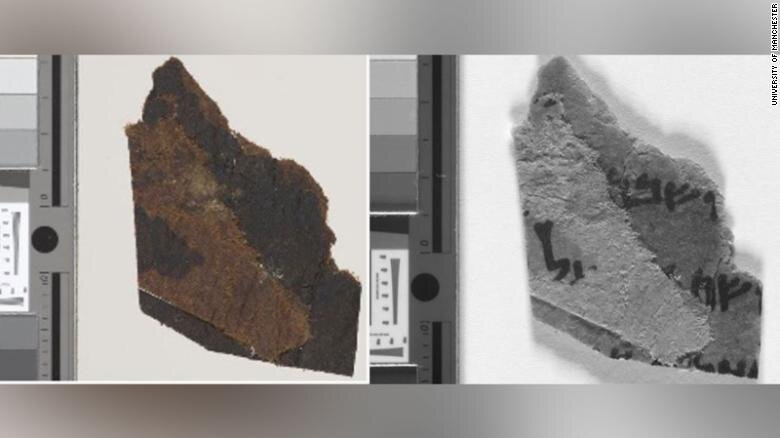
Researchers have found that four of the 51 fragments believed to have been blank do, in fact, contain readable Hebrew/Aramaic text. They just needed a special camera to see it.

The surprise discovery is notable because scholars have long tried to gain a better understanding of the Dead Sea Scrolls, which are some of the oldest versions of the Hebrew Bible and other religious texts that date to the time of Jesus.

Read More: CNN

Comment

Comment

Israeli drinking-water generator donated to Gaza hospital

(Photo: Mayet Al Ahel)

(Photo: Mayet Al Ahel)

By Abigail Klein Leichman - May 17, 2020

Children and staff at Gaza’s only pediatric cancer hospital now have access to safe drinking water thanks to an atmospheric water generator (AWG) from Israel’s Watergen.

Pulling water out of air is a remarkable feat. And so was getting the 780-kilo GEN-M machine to Gaza City from Israel via the Kerem Shalom border crossing.

Due to ongoing attacks launched from the Hamas-ruled Gaza Strip, Israel carefully controls the transfer of materials through Kerem Shalom. And the coronavirus crisis has further limited cross-border activity.

But Watergen President Michael Mirilashvili was determined to help once he found out about the hospital’s dire need from Fayez Husseini of Mayet Al Ahel, a Palestinian Authority company that facilitates water and power projects in Gaza. (Mayet Al Ahel means “community drinking water” in Arabic.)

“When the Palestine Children’s Relief Fund informed us of the water situation and how it is affecting the cancer ward, the project and timing were challenging,” Husseini said.

Read More: Israel21c

Comment

Comment

Etihad makes first known commercial flight between UAE and Israel

(Photo: AP Photo/Kamran Jebreili, File)

(Photo: AP Photo/Kamran Jebreili, File)

By AP - May 19, 2020

Etihad Airways said Tuesday it would fly aid to Israel for the Palestinians amid the coronavirus pandemic, marking the first known direct commercial flight between the nations.

The flight comes as the United Arab Emirates, home to Abu Dhabi and Dubai on the Arabian Peninsula, has no formal diplomatic ties to Israel over its control of land wanted by the Palestinians for a future state.

However, it marks an open moment of cooperation between the countries after years of rumored back-channel discussions between them over the mutual enmity of Iran.

Read More: Times of Israel

Comment

Comment

Living underground before the Romans? 2,000-year-old rooms found by Western Wall

(Photo: Yaniv Berman/Israel Antiquities Authority)

(Photo: Yaniv Berman/Israel Antiquities Authority)

By Amanda Borschel-Dan - May 19, 2020

A singular two-millennia-old subterranean system of three rooms has been uncovered near the Western Wall. The three-room complex — painstakingly chiseled by hand out of bedrock prior to the fall of Jerusalem in 70 CE — is the first evidence of everyday life gone underground in the ancient city.

“This is a unique finding. This is the first time a subterranean system has been uncovered adjacent to the Western Wall,” said Israel Antiquity Authority co-directors Dr. Barak Monnickendam-Givon and Tehila Sadiel in a press release Tuesday.

“You must understand that 2,000 years ago in Jerusalem, like today, it was customary to build out of stone [blocks]. The question is, why were such efforts and resources invested in hewing rooms underground in the hard bedrock?” said the archaeologists.

The purpose of the three-room complex, hidden for centuries under a large 1,400-year-old Byzantine/Umayyad structure’s white mosaic floor, is still being investigated, but it may have served as a basement pantry, living space, or even a place to hide during raids, excavation co-director Dr. Barak Monnickendam-Givon told The Times of Israel on Tuesday.

Read More: Times of Israel

Comment

Comment

Dead Sea Scrolls secrets revealed live online this week

(Photo: Shai Halevi/Israel Antiquities Authority)

(Photo: Shai Halevi/Israel Antiquities Authority)

By Israel21c Staff - May 18, 2020

The public is invited to listen to more than three dozen scholars from Israel and around the world sharing new research and discoveries about the Dead Sea Scrolls online through May 20.

This first-of-its-kind virtual conference is presented free by the Friends of the Israel Antiquities Authority in collaboration with New York University, Global Network for Advanced Research in Jewish Studies and NYU’s Skirball Department of Hebrew and Judaic Studies.

The Dead Sea Scrolls are fragments of ancient manuscripts discovered between 1947 and 1956 in 11 caves near Qumran, on the northwestern shores of the Dead Sea. They are approximately 2,000 years old, written mainly in Hebrew, on parchment or papyrus. Scholars have reconstructed approximately 950 different manuscripts of various lengths.

Read More: Israel21c

Comment

Comment

Nurturing And Tough: The Israeli Women Blazing Trails In Tel Aviv's Culinary Scene

(Photo: A table at Meshev Barzilay)

(Photo: A table at Meshev Barzilay)

By Liz Vaknin - March 9, 2020

From New York to London, Paris, Amsterdam, and back to Tel Aviv and Jerusalem, Israeli cuisine has been taking the global culinary scene by storm for over a decade. Multinational restaurant groups helmed by celebrity culinary figures like Assaf Granit and Eyal Shani have been making waves abroad with their modern approach to Israeli cuisine, but so have female chefs like Einat Admony and Gazala Halabi who, in their hustle to succeed in a male-dominated industry, have completely stolen the hearts of critics and diners alike.

And they are by far not the only ones. In Israel, female chefs like Naifa Mulla of experimental culinary platform L28 and Game of Chefs series winner Avishag Levy are just a few who have stood out for their creativity.

Read More: No Camels

Comment

Comment

Almost all Israeli kids to return to school Sunday as education system reopens

(Photo: Olivier Fitoussi/Flash90)

(Photo: Olivier Fitoussi/Flash90)

By TOI Staff - May 14, 2020

The education system is set to return to full operation on Sunday in most of the country, the Prime Minister’s Office announced Thursday, after some two months during which Israeli children were ordered to stay home in order to contain the spread of the coronavirus.

The statement said Prime Minister Benjamin Netanyahu had approved the plan, devised jointly by PMO Director-General Ronen Peretz, the National Security Council, the education, finance and health ministries and local authorities.

Read More: Times of Israel

Comment